
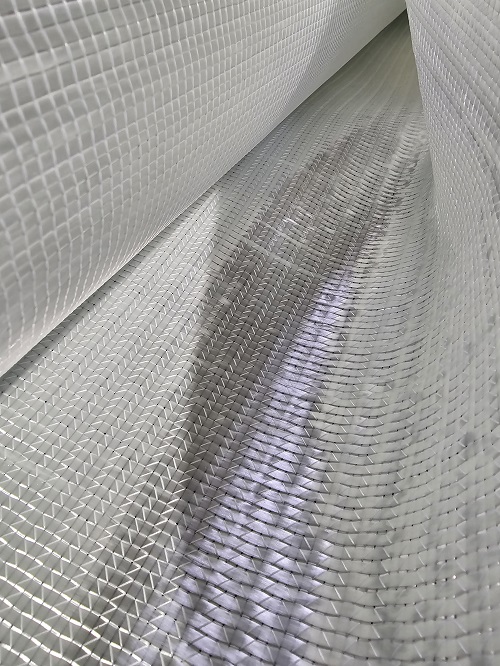
Biaxial E-Glass Cloth 0°/90°- 800 gsm – Per Metre

$7.70 incl. GST
Ideal for structural laminates that need genuine two-axis strength. Uncrimped fibres lie flat for maximum stiffness and clean resin wet-out. Compatible with polyester, vinyl ester, epoxy, and urethane-acrylate. Suitable for hand layup, vacuum bagging, and resin infusion.
Weave type: Biaxial/Double bias 0/90 degrees
Weight: 800 gsm
Width: 1270 mm
NOTE: Price is per linear meter
Description
Biaxial E-Glass Cloth 0°/90° 800gsm — Heavy-Duty Structural Reinforcement
Built for strength in two directions. Ready to work.
When a laminate needs to handle load from multiple directions, the Biaxial E-Glass Cloth 0/90 800gsm delivers. This 1270mm wide stitched fabric places equal-weight glass bundles at true 0° and 90° — held in place with strong polyester stitching (83 dtex) rather than woven over and under. As a result, the fibre lies flat, wets out cleanly, and puts more of the glass to work.
The Structural Case for 830gsm Biaxial
Crimping is the enemy of composite strength. When a fibre bends out of plane, you lose stiffness and tensile performance. Because this fabric is stitched rather than woven, fibres stay straight from roll to laminate — giving you higher in-plane stiffness than an equivalent woven roving.
At 800gsm, you build thickness fast. Fewer plies means less handling time and less risk of consolidation error. For that reason alone, it’s a practical choice on medium to large structural jobs.
Stabilisation fibres also run throughout the fabric. Consequently, the structure stays intact during cutting, handling, and wet-out — which matters most in infusion setups where fibre movement before resin flow causes problems.
Key Performance Advantages
This is what sets 830gsm biaxial E-glass cloth apart from standard woven roving:
- Non-crimp fibre alignment — fibres run straight, so they contribute their full strength and stiffness to the finished laminate
- Strong 0°/90° reinforcement — equal glass in both axes handles multi-directional loading without extra off-axis plies
- Improved laminate stiffness — stitched NCF construction consistently outperforms woven equivalents in stiffness testing
- Excellent resin wet-out — the open, stable structure takes resin cleanly in hand layup, vacuum bagging, and infusion
- Reduced print-through — when placed away from the gel coat, the flat face keeps visible surfaces clean
- Wide resin compatibility — works with polyester, vinyl ester, epoxy, and urethane-acrylate without changing the fabric
- Fast thickness build — at 830gsm per ply, you reach your target laminate weight in fewer layers
800gsm Biaxial vs. Comparable Reinforcements
| Fabric Type | Areal Weight | Fibre Orientation | Crimp | Stiffness | Best For |
|---|---|---|---|---|---|
| Woven Roving 600gsm | 600 g/m² | 0°/90° | Yes | Moderate | General structural, hand layup |
| Woven Roving 800gsm | 800 g/m² | 0°/90° | Yes | Moderate–High | Heavy marine, bulk laminate |
| Biaxial E-Glass Cloth 0/90 800gsm | 800 g/m² | 0°/90° stitched | None | High | Structural panels, infusion, tooling |
| Biaxial NCF ±45° | Variable | ±45° | None | High (shear) | Torsion and shear-dominant parts |
| Triaxial NCF | Variable | 0°/±45° | None | Very High | Complex load paths, aerospace |
Overall, the 830gsm biaxial gives you the best combination of build speed, two-axis stiffness, and process flexibility at this weight class.
Surface Quality & The Print-Through Advantage
Print-through is one of the most common finish defects in structural glasswork. It happens when the fabric pattern shows through the gel coat — and it’s avoidable.
Because this biaxial cloth has a flat, even face, placing a fine surface tissue or CSM between the fabric and the gel coat removes the problem. So you get a laminate that’s strong internally and clean on the surface — which matters in marine, transport, and architectural work.
Typical Applications
This fabric is used across a wide range of industries. In each case, the combination of stiffness, build rate, and process flexibility makes it the practical choice for structural FRP work.
- Marine & Boat Building — hull skins, deck panels, stringers, and transom reinforcements; well suited to large-format infusion jobs
- Wind Energy — spar caps, root sections, and blade shells; handles primary bending loads cleanly through long infusion cycles
- Construction & Infrastructure — structural GRP panels, tanks, enclosures, and architectural cladding
- Automotive & Transport — body panels, chassis parts, and commercial vehicle components via vacuum bagging or infusion
- Defence & Aerospace — secondary structures, fairings, and skins where glass reinforcement meets tight weight and stiffness targets
- Tooling & Moulds — stiff, stable mould skins and backup laminates where dimensional accuracy matters
- Drones & UAV Platforms — structural ribs and airframe sections where two-axis stiffness is needed at a sensible cost
Technical Specifications
| Property | Specification |
|---|---|
| Areal Weight | 800 g/m² (±5%) |
| Construction | Stitched biaxial NCF |
| Fibre Orientation | 0° / 90° |
| Fibre Type | E-glass |
| Stitching Yarn | Polyester, 83 dtex |
| Fabric Width | 1270mm (50″) |
| Stabilisation | Yes — throughout |
| Fibre Crimp | None |
| Compatible Resins | Polyester, Vinyl Ester, Epoxy, Urethane-Acrylate |
| Processing Methods | Hand layup, Vacuum Bagging, Resin Infusion |
| Surface Finish | High — suitable for visible laminates with correct ply sequence |
| Sold As | Per linear metre / full roll |
Contact us for roll pricing, datasheets, and volume lead times.
Why Source From Enhanced Composites
There’s no shortage of fibreglass suppliers. However, finding one that stocks the right material, prices it fairly, and actually understands how it gets used is less common.
Enhanced Composites holds this 800gsm biaxial E-glass cloth as a live stocked line — not a catalogue item you wait weeks for. Furthermore, pricing is built for trade customers running real volumes, not one-off retail orders.
The range also covers the full laminate schedule. Whether you need a 300gsm surface fabric, a 600gsm woven roving for mid-plies, or this 830gsm biaxial for primary structure, you can source it all from one place.
Related products

Fibreglass

Double Bias
Chopped Strand Mat (CSM)
PP Core Combo Mat 780gsm (300gsm CSM/PP 180gsm/300gsm CSM) – Full Roll

Multiaxial / Stitched Fabrics

Multiaxial / Stitched Fabrics
Multiaxial / Stitched Fabrics
Multiaxial / Stitched Fabrics
Multiaxial / Stitched Fabrics