

Description
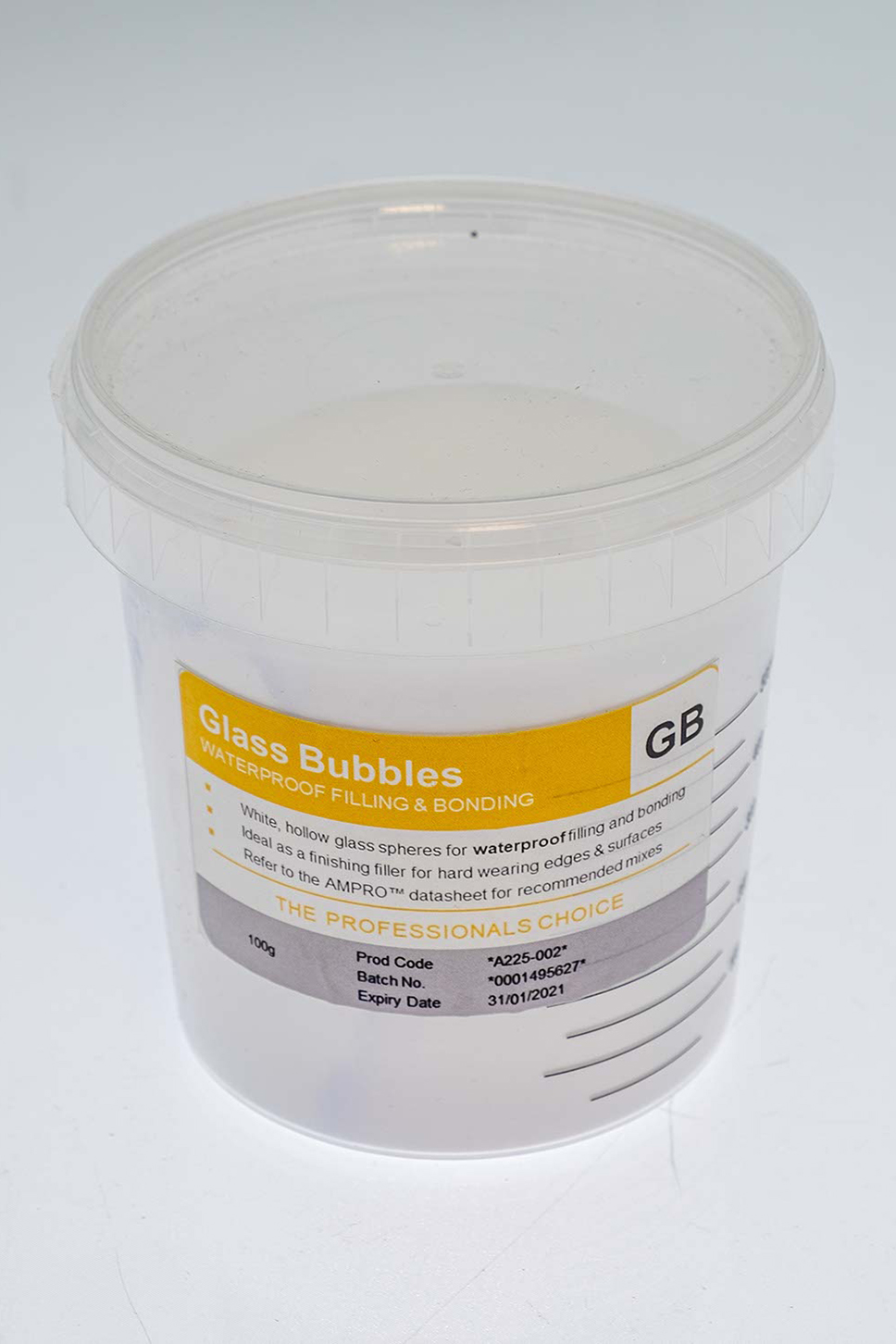
Gurit Glass Bubbles Filler – White Waterproof Epoxy Filler
Waterproof. Hard wearing. Lower cost than microballoons.
Glass bubbles filler is a white hollow glass sphere filler used with epoxy resin systems to create waterproof filling, fairing, and low-strength bonding compounds. At 500ml / 90g, this glass bubbles filler suits below-waterline marine applications, hard surface finishing, and general composite filling work where waterproofing matters more than easy sanding. Furthermore, being significantly less expensive than microballoons, it’s the practical choice wherever cost efficiency and moisture resistance are both on the brief.
Glass Bubbles vs. Microballoons — Understanding the Difference
Both glass bubbles and microballoons are hollow sphere fillers that increase volume and reduce density in a resin system. However, they’re not interchangeable — and choosing the right one depends entirely on what the finished compound needs to do.
Glass bubbles are composed chemically of glass, which makes them physically harder than microballoons. Consequently, filled resin mixes are noticeably more difficult to sand — but they also produce a more waterproof compound and a harder surface finish. As a result, glass bubbles suit below-waterline applications, hard-wearing edges, and surfaces where moisture resistance is the primary requirement.
Moreover, glass bubbles can be mixed with microballoons in any proportion — useful when colour matching or blending sanding performance with waterproofing is needed in the same compound.
Glass Bubbles vs. Microballoons — Quick Reference
| Property | Glass Bubbles | Microballoons |
|---|---|---|
| Colour | White | Brown |
| Sanding | Moderate — harder to sand | Easy |
| Water Resistance | High — waterproof | Moderate |
| Cost | Lower | Higher |
| Best For | Below waterline, hard surfaces, general filling | Fairing, above waterline, easy finishing |
| Can Be Mixed Together | Yes — any proportion | Yes — any proportion |
Key Performance Advantages
- Waterproof filler compound — higher moisture resistance than microballoons, suited to below-waterline and exterior applications
- Hard surface finish — physically harder than microballoon compounds, therefore suited to hard-wearing edges and surfaces
- Lower cost than microballoons — most cost-effective hollow sphere filler for general filling and fairing applications
- White colour — clean white finish suits visible and painted surfaces without colour bleed
- Mixable with microballoons — blend in any proportion to adjust sanding performance or colour as needed
- Low density — increases resin volume efficiently without adding meaningful weight to the compound
- 2 year shelf life — stable in sealed containers stored in a warm dry place
Mixing Guide — Filling & Fairing
Mix epoxy resin and hardener thoroughly before gradually adding glass bubbles. Approximate loadings for filling and fairing mixes:
- Filler quantity: 35–40% by weight (350–400g per 1kg mixed resin system)
- Silica addition: 3–5% by weight (30–50g per 1kg) for anti-sag on vertical surfaces
- Approx. density: 0.5 g/cm³
- Approx. volume yield: 3.0 litres per 1kg resin system
Mixing Guide — Adhesive Mixes
- Filler quantity: 15–20% by weight (150–200g per 1kg mixed resin system)
- Silica addition: 4–6% by weight (40–60g per 1kg)
- Approx. density: 0.6 g/cm³
- Approx. volume yield: 2.0 litres per 1kg resin system
Note: Microfibres are always preferred for load-carrying structural adhesive joints.
Typical Applications
- Below-Waterline Marine Fairing — waterproof filler compound for filling and fairing hull surfaces below the waterline where moisture resistance is essential
- Hard Surface Finishing — hard-wearing filler for edges, corners, and surfaces subject to abrasion or impact
- General Composite Filling — lowest-cost hollow sphere filler for void filling, fairing, and general surface preparation on composite parts
- Low Strength Timber Bonding — adhesive compound for low-strength bonding of softwood components
- Marine Repair — waterproof filler for osmotic blister repairs, void filling, and below-waterline surface preparation
- Colour Blending — mixed with microballoons in any proportion to achieve desired colour or sanding performance in composite filler compounds
Technical Specifications
| Property | Specification |
|---|---|
| Product | Gurit Glass Bubbles |
| Appearance | White powder |
| Composition | C-Class hollow glass spheres |
| Particle Size | 40–80 microns |
| Particle Density | 200 g/litre approx. |
| Bulk Density | 100–150 g/litre approx. |
| Water Resistance | High |
| Sanding | Moderate — harder than microballoons |
| Compatible With | Epoxy resin systems |
| Shelf Life | 2 years in sealed container |
| Pack Size | 500ml / 90g (A230-005) |
| Other Sizes Available | 1–2 litre (A230-001) / 30 litre (A230-003) |
Health & Safety
- Wear protective gloves — disposable nitrile gloves recommended for most applications
- Wear protective clothing when mixing, laminating, or sanding
- Wear eye protection — if contact occurs, flush with water for 15 minutes and seek medical attention
- Ensure adequate ventilation — wear respiratory protection if ventilation is insufficient
- Avoid inhalation of dust during mixing and sanding
- If skin becomes contaminated, cleanse immediately with resin-removing cleanser then wash with soap and warm water
- Wash hands before eating, drinking, smoking, or using the lavatory
Why Enhanced Composites
Enhanced Composites stocks Gurit glass bubbles filler alongside the full range of epoxy resin systems, composite fabrics, and laminating consumables. Moreover, no minimum order applies and dispatch is fast across Australia. So whether this is a one-off repair job or a regular production requirement, everything needed comes from the same account.
Need larger sizes — 1–2 litre or 30 litre? Email info@enhancedcomposites.com.au
Additional information
| Size | 90 GR (500ml), 0.3 kg |
|---|
Related products
Fillers & Additives
Fillers & Additives

Fillers & Additives
Fillers & Additives